Lord Krishna’s childhood is filled with grand and awe-inspiring events, including the defeat of great demons and the lifting of mighty hills. Yet the prime one is the evening when Mother Yashoda picked up a rope. In that small, homely moment, the boundless, unconquerable Supreme Lord chose to be held by the innocent, overflowing love of His own mother.
This is Damodar Lila, the cherished Krishna Damodar pastime remembered by devotees across the world, a story so sweet that it has been sung, retold and wept over in the homes and temples for thousands of years, especially throughout the sacred month of Kartik.
What is Damodar Lila?
Damodar Lila refers to the beautiful pastime in which young Krishna was very mischievous and, one of his mischiefs, was caught. So he was bound around His belly with a rope by His loving mother, Yashoda.
Described in the Srimad Bhagavatam, this pastime beautifully illustrates a truth that devotees hold very close to their hearts: that the Supreme Personality of Godhead, whom no yogi or mystic can ever hope to control, willingly submits Himself to the pure, unconditional love of His devotee.
The story is playful and deeply emotional all at once, being a glimpse into the intimate exchanges of love between Krishna and His devotees in Vrindavan, where the Lord of all creation becomes, for a few precious moments, simply a beloved child being disciplined by His mother.
Why is Krishna Called "Damodara"?
The name Damodara comes from two Sanskrit words, dama meaning rope, and udara meaning belly; together, it means He whose belly was bound by a rope. This beautiful name appears as the three hundred and sixty-seventh name of our beloved Lord in the Vishnu Sahasranama, and it is by this name that devotees affectionately remember Krishna throughout the sacred month that bears His name.
The name Damodara is one of the Lord’s most endearing names, revealing the extraordinary sweetness of divine love. The unconquerable Lord willingly allows Himself to be conquered by the pure affection of His devotee, showing that His divine nature shines most beautifully in choosing to come under the shelter of love.
The Story of Damodar Lila: How Yashoda Bound Krishna?
This story of how Yashoda binds Krishna is one of the most cherished in all of Vaishnava literature, remembered every year with fresh tenderness. One day, while Mother Yashoda was busy churning butter and softly singing songs about her beloved son's pastimes, little Krishna appeared before her, hungry and eager to be fed. She lifted Him onto her lap and began nursing Him with great affection, but just then the milk on the hearth began to boil over, and she had to set Krishna aside to look into it.
Left alone and unsatisfied, Krishna grew upset. In His childlike anger, He broke a pot of fresh butter kept nearby and began generously distributing the butter inside it to the monkeys in the courtyard. When Mother Yashoda returned and saw what had happened, she searched for her mischievous son and finally found Him seated on an overturned wooden mortar, still sharing butter with His monkey friends.
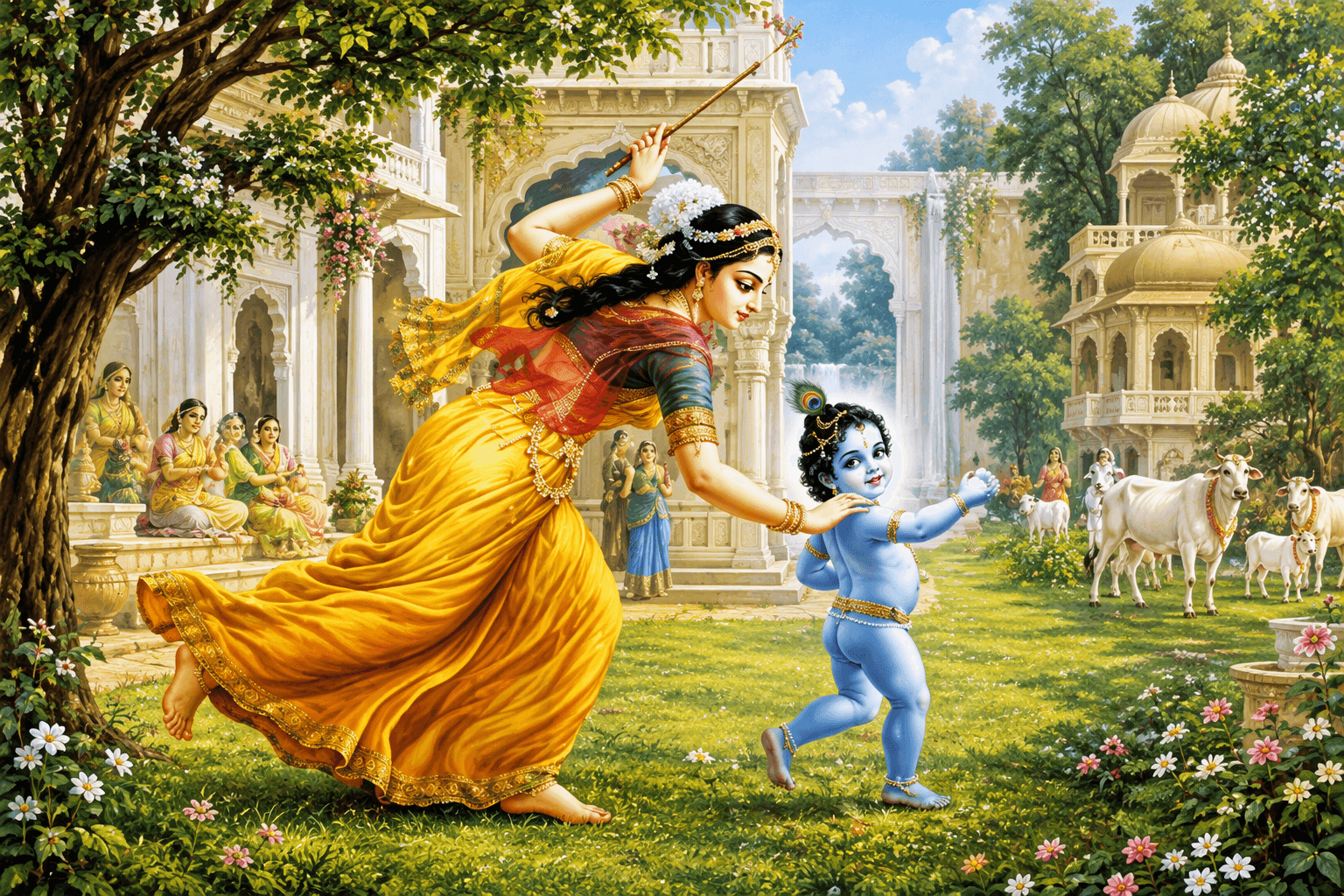
Seeing His mother approaching with a stick in her hand, Krishna fled, and a loving chase followed through the courtyard of Nanda’s home until Yashoda finally caught Him. Wishing to teach Him a lesson, she decided to bind Him to the wooden grinding mortar. No matter how many ropes she joined together, the length always fell short by two fingers.
Exhausted, Yashoda continued her attempt, and Krishna, deeply touched by the sheer purity and intensity of His mother's love, at last allowed Himself to be bound. It was not the rope that finally held Him, but it was her devotion, for the Lord that can never be bound by anything except the love of His devotee. From that day forward, He became known as Damodara, the one who was bound, not by force, but by love alone.
The Liberation of Nalakuvara and Manigriva
Once bound to the mortar, Krishna, ever playful, noticed two tall trees standing in the courtyard. These were no ordinary trees, for in their previous lives they had been Nalakuvara and Manigriva, two proud sons of Kuvera, the treasurer of the demigods.
Once, while bathing, intoxicated with celestial maidens, the two had behaved shamelessly in the presence of the sage Narada Muni, and in his mercy the sage cursed them to become trees. This curse also carried within it the promise of eventually beholding the Lord Himself.
Dragging the heavy wooden mortar behind Him as He crawled, Krishna made His way between the two trees. As the mortar became wedged and the trees came crashing down with a tremendous sound, two radiant celestial beings emerged from within, Nalakuvara and Manigriva, now freed from their long curse. Overwhelmed with gratitude, they offered heartfelt prayers to the Lord before returning to their heavenly abode.
This part of the pastime beautifully reminds every devotee that even a curse, when touched by the mercy of a pure soul like Narada Muni, can become the very path that leads one back to the Lord.
Damodarashtakam: The Prayer Glorifying This Pastime
The Damodarashtakam is a tender eight-verse prayer glorifying this very pastime, composed by the sage Satyavrata Muni and recorded within the Padma Purana. Traditionally sung each evening throughout the month of Kartik, this prayer captures the deep emotions of separation and longing felt by devotees as they meditate upon Krishna's childhood pastimes in Vrindavan.
The Hari Bhakti Vilasa itself instructs devotees to worship Lord Damodara and recite this prayer daily throughout Kartik, a practice cherished across Vaishnava temples worldwide. Within its verses, Satyavrata Muni beautifully expresses a devotee's deepest desire, not for liberation or any material benediction, but simply for the eternal vision of Krishna's own beautiful childlike form to remain forever within our heart.
Significance of Damodar Lila in ISKCON in the Kartik Month
Within ISKCON and the wider Vaishnava tradition, Damodar Lila holds a place of very special significance, as it forms the spiritual heart of the entire Kartik month. Each evening throughout this sacred period, devotees offer a lit ghee lamp before the deity of Damodara while singing the Damodarashtakam, a practice known as Deep Daan, believed to bring immense purification and closeness to the Lord.
This pastime also carries a profound teaching that devotees hold dear: that the Supreme Lord values sincere love far above ritual perfection or outward show. Just as Krishna surrendered to the simple love of His mother, devotees are reminded that their own small, heartfelt offerings, however humble, are what truly draw them closer to Him.
Damodar Lila Celebrations at ISKCON Attapur
Every Damodar Lila ISKCON celebration at Bhiwandi comes alive each Kartik season through joyful evening gatherings centred around Deep Daan and the singing of the Damodarashtakam before our God, Sri Sri Radha Madhava. Devotees are warmly invited to bring a lamp, join the kirtan, and hear the pastime retold with the same love and wonder that has touched hearts for generations.
Discover our ongoing seva opportunities through our Kartik seva offerings. Devotees living far away are also welcome to join us in spirit through our spiritual discourse videos, or to browse further devotional reading on our ISKCON Attapur blogs page. Whatever form your participation takes, we invite you to let this beautiful pastime remind you, as it has reminded devotees for centuries, that the Lord can only be bound by love.
FAQs
Is Damodar Lila the same as Govardhan Puja or Diwali?
No, Damodar Lila is a distinct pastime from both Govardhan Puja and Diwali, though all three are celebrated within a similar season. While Diwali marks the festival of lights and Govardhan Puja commemorates Krishna lifting Govardhan Hill, Damodar Lila specifically refers to the pastime of Mother Yashoda binding young Krishna, remembered and celebrated throughout the entire month of Kartik.
At what age did Krishna perform the Damodar Lila?
According to the Srimad Bhagavatam, Krishna was still a very young child, generally described as being under two years of age, when this pastime took place in Vrindavan. It occurred during the same early period of His childhood that also included the breaking of the butter pot and other beloved pastimes fondly remembered by devotees.
Can devotees observe Damodara Vrata even if they can't visit a temple?
Yes, devotees anywhere in the world can observe Damodara Vrata at home with equal sincerity. Offering a simple lamp before a picture or deity of Krishna each evening, reciting the Damodarashtakam, and remembering this pastime with a loving heart is considered a complete and deeply meaningful way to keep the spirit of Damodar Lila alive.